
Frequently Asked Questions (Patient Q&A)
Q1: Does wisdom tooth extraction hurt?
Answer: The procedure itself is entirely painless. Thanks to modern local anesthesia and sedation options, you will only feel pressure and movement, but zero sharp pain. Mild discomfort occurs during the recovery phase, which is easily managed with prescribed painkillers.
Q2: When is it absolutely necessary to remove my wisdom tooth?
Answer: Removal is mandatory if the tooth is "impacted" (stuck inside the jaw), causing chronic jaw pain, creating deep gum pockets that trap food and bacteria, or growing at an angle that threatens to decay or destroy the neighboring second molar.
Q3: Can I keep my wisdom teeth if they don't hurt?
Answer: Yes, but only if they have fully erupted, are positioned correctly, and can be easily cleaned with a toothbrush. However, many dentists recommend proactive removal in your late teens or early twenties to prevent future complications when the jawbone becomes denser and surgery becomes more difficult.
Q4: How long does the pain and swelling last after extraction?
Answer: Swelling usually peaks on the second or third day post-surgery. Severe discomfort subsides within 3 to 4 days, while complete healing of the extraction socket takes a few weeks.
1. Overview: What Are Wisdom Teeth?
Wisdom teeth, clinically known as third molars, are the final set of permanent teeth to emerge in the human mouth. They typically erupt at the very back of the upper and lower jaws between the ages of 17 and 25—a time historically associated with the onset of "wisdom," hence the name. From an evolutionary standpoint, these robust molars were essential for our ancestors who survived on a coarse diet of raw meats, roots, and tough foliage. However, as human diets softened over millennia and our jawbones gradually became smaller, these extra teeth lost their primary function. Today, the modern human jaw often lacks the adequate space required to accommodate them, leading to a myriad of dental complications.
2. Understanding "Impacted" Wisdom Teeth
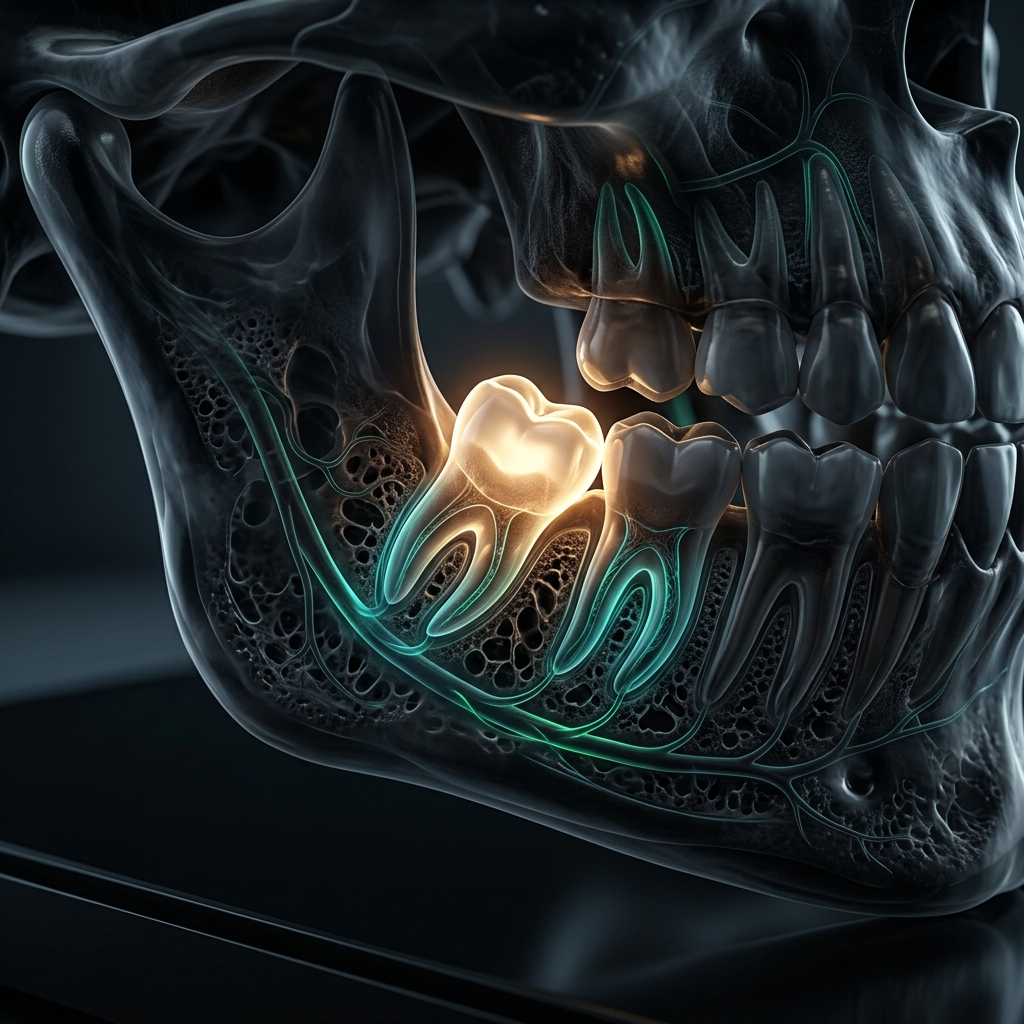
When a wisdom tooth does not have sufficient room to emerge naturally, it becomes trapped beneath the gums or within the jawbone—a condition known as an impacted wisdom tooth. Impactions are categorized based on the angle at which the tooth is trapped:
- Mesial Impaction: The most common type, where the tooth is angled forward toward the front of the mouth, pushing directly against the neighboring second molar.
- Vertical Impaction: The tooth is oriented perfectly straight but remains trapped beneath the gum line or bone due to a lack of physical space.
- Horizontal Impaction: The most complex scenario, where the tooth is lying completely flat parallel to the jawbone, directly threatening the roots of adjacent teeth.
- Distal Impaction: The rarest form, where the tooth is angled backward, away from the rest of the dental arch.
3. Warning Signs and Symptoms: Do You Need Surgery?
While some impacted wisdom teeth are asymptomatic and only discovered via a panoramic X-ray, many will eventually trigger a cascade of aggressive symptoms. You should urgently consult an oral surgeon if you experience:
- Throbbing Jaw Pain: A constant, dull ache at the back of the jaw that may radiate to the ear or cause severe headaches.
- Swollen, Bleeding Gums: Partially erupted teeth create a flap of gum tissue (operculum) that acts as a trap for food debris and bacteria, leading to a highly painful infection known as pericoronitis.
- Halitosis (Chronic Bad Breath): An inability to properly clean the extreme back of the mouth results in bacterial buildup and a persistent bad taste.
- Trismus (Lockjaw): Severe inflammation spreading to the chewing muscles, making it intensely painful or physically impossible to open your mouth fully.
- Cyst Formation: In neglected cases, a fluid-filled sac (cyst) can develop around the unerupted tooth, hollow out the jawbone, and permanently damage nearby nerves.
4. Upper vs. Lower Extractions: The Crucial Differences
A common misconception is that all wisdom tooth extractions are identical. In reality, the location of the tooth drastically dictates the complexity of the surgery:
Upper Wisdom Teeth (Maxillary): These extractions are typically straightforward. The bone in the upper jaw is relatively porous and softer, and gravity assists the surgeon. Upper molars are rarely deeply impacted, meaning the procedure is often rapid, with minimal post-operative swelling.
Lower Wisdom Teeth (Mandibular): This is where true surgical expertise is required. The lower jawbone is incredibly dense. Lower wisdom teeth are frequently heavily impacted and lie dangerously close to the Inferior Alveolar Nerve (the nerve supplying sensation to your lower lip, chin, and tongue). Extracting a lower molar often requires the surgeon to meticulously peel back the gums, remove obstructing bone, and section (cut) the tooth into smaller, safer fragments for removal.

5. The Surgical Procedure: What to Expect in the Chair
The fear of the dentist chair is common, but understanding the highly controlled surgical protocol can alleviate anxiety. The procedure generally follows these steps:
- Anesthesia Administration: Depending on the case complexity and your anxiety levels, you will receive local anesthesia (numbing injections), IV sedation (twilight sleep), or, for extremely complex hospital cases, general anesthesia.
- Tissue Incision & Bone Removal: If the tooth is impacted, the surgeon makes a precise incision in the gum tissue to expose the hidden tooth and bone. Any bone blocking access to the tooth root is carefully removed using specialized surgical instruments.
- Tooth Sectioning & Extraction: To minimize trauma to the jaw and surrounding nerves, the surgeon will divide the tooth into sections rather than attempting to forcefully pull it out whole.
- Cleaning & Suturing: The extraction socket is thoroughly irrigated to remove any remaining debris or bone fragments. The wound is then closed using dissolvable stitches to promote optimal healing.
6. Day-by-Day Recovery and Aftercare Rules
The surgical extraction is only half the battle; strict adherence to post-operative aftercare is critical. Complications like the dreaded "Dry Socket" (Alveolar Osteitis)—where the protective blood clot is dislodged, exposing raw bone and nerves—are almost entirely preventable by following these rules:
Day 1: The Critical 24 Hours
- Bite and Hold: Bite down firmly on the provided sterile gauze for 30 to 45 minutes to encourage blood clot formation.
- Ice is Your Friend: Apply an ice pack to the outside of your face (15 minutes on, 15 minutes off) to constrict blood vessels and dramatically reduce incoming swelling.
- Zero Suction: Absolutely no drinking through a straw, no smoking, and no forceful spitting. The vacuum effect in your mouth will violently rip the blood clot out of the socket.
- Liquid Diet: Consume only cold or lukewarm liquids and purees (yogurt, smoothies, applesauce). Avoid anything hot that could dissolve the clot.
Days 2-3: Peak Swelling
- Swelling and bruising will likely reach their maximum during this window. Transition from ice packs to warm, moist compresses to increase blood flow and resolve the swelling.
- Introduce slightly more solid but soft foods (scrambled eggs, mashed potatoes, well-cooked pasta).
- Begin gentle oral hygiene. Do not brush directly over the surgical site. Start rinsing your mouth gently with warm salt water (1/2 teaspoon of salt in a cup of water) every few hours to keep the wound sterilized.
Days 4-7: The Healing Phase
- Pain should be significantly reduced and easily managed with over-the-counter NSAIDs like Ibuprofen.
- The dissolvable stitches will begin to fall out naturally. You can slowly return to a normal diet, though you should still avoid excessively crunchy foods (like nuts or chips) that could stab the healing gum tissue.
Need a Specialized Maxillofacial Surgeon?
Wisdom tooth extraction—especially for deeply impacted lower molars—is a delicate surgery that requires absolute precision to avoid nerve damage and infections. Do not leave your oral health to chance.
The EDC Hub Digital Triage System instantly connects you with the highest-rated, verified maxillofacial surgeons and specialized dental clinics in your area. Get an accurate diagnosis, transparent pricing, and world-class surgical care.
Book a Surgeon Consultation Now